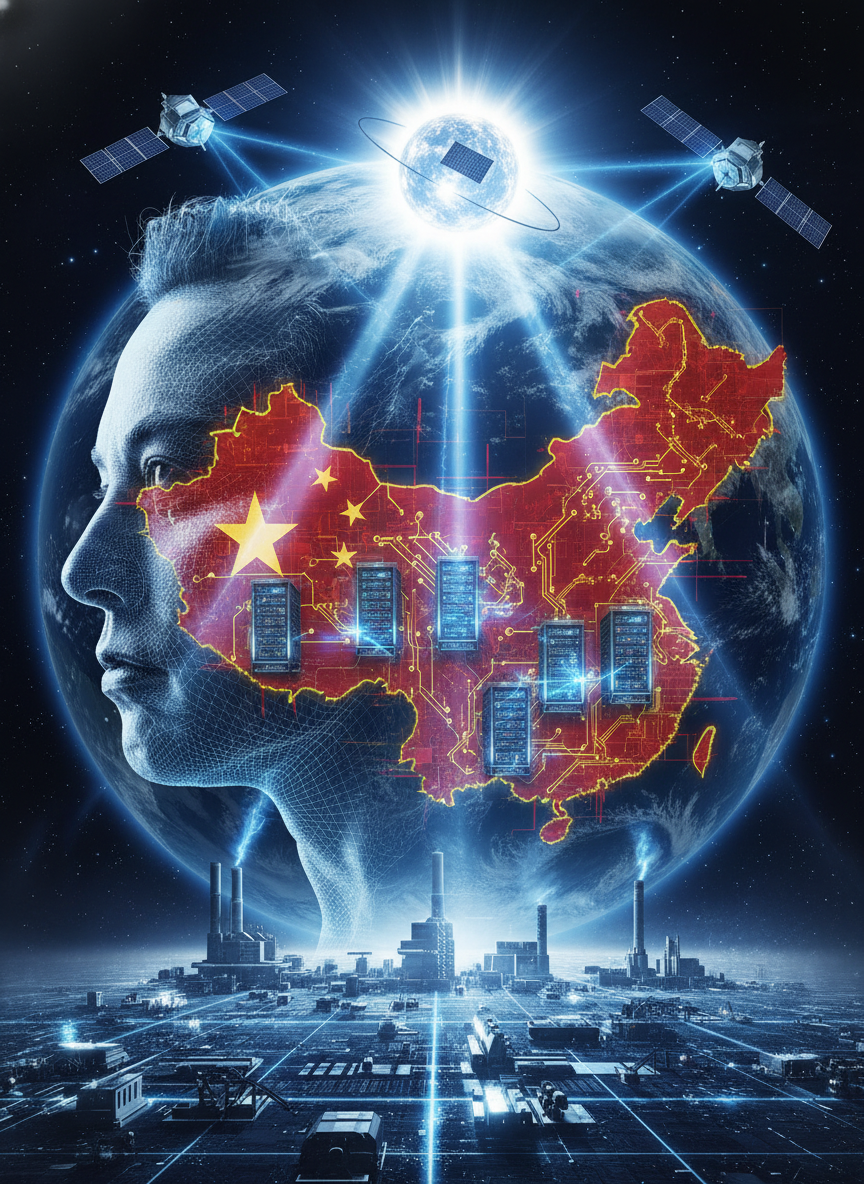
Elon Musk Predicts AI and Energy Revolution by 2026, Foresees China's Global Leadership
1/10/2026 LJG2
LJG2
LJG2Elon Musk, in a recent interview, presented his predictions on the evolution of artificial intelligence, emphasizing the pivotal role of energy supply in the impending AGI breakthrough. Musk anticipates China’s imminent dominance in AI computing and power capacity, discusses the potential of space-based solar energy, and calls attention to the need for responsible stewardship as AI transforms societies worldwide.
Elon Musk's recent interview on January 7, 2024, provided a comprehensive outlook on the future trajectory of artificial intelligence and the critical role of energy infrastructure. Musk identified 2026 as a decisive year for the realization of artificial general intelligence (AGI), indicating a forthcoming transformative leap in AI capabilities. According to Musk, this advancement is expected to accelerate innovation cycles and lead to widespread automation, particularly impacting numerous white-collar professions.
Central to Musk's analysis is the assertion that energy supply, specifically access to large-scale and cost-effective electricity, represents the fundamental constraint in the development and deployment of advanced AI systems. He repeatedly highlighted that the competition in the AI sector would ultimately hinge upon which entity could resolve the challenges of massive energy provision, suggesting that dominance in AI would be contingent upon breakthroughs in electricity generation and its efficient distribution.
Musk also delineated a changing global landscape where China is poised to assume a leading position in AI-related computational power and energy production. He forecasted that by 2026, China's electricity generation capacity would reach three times that of the United States, establishing a strong foundation for AI research and applications. Musk's comments underscore a significant strategic shift, with China's rapid scaling of energy and computing resources redefining competitive dynamics in the technology sector.
A notable aspect of Musk's vision pertains to innovative energy solutions, specifically the deployment of 'space solar power' combined with AI-driven satellites. He proposed the ambitious goal of constructing 100 gigawatts of space-based solar energy annually. This new energy architecture is envisioned as a critical enabler for the sustained growth and acceleration of AI technologies and the broader digital economy, offering a path toward robust and renewable electricity supply on a global scale.
The anticipated integration of AI is expected to reshape labor markets and social structures fundamentally. Musk described a transition where humans serve as "biological guides" for the evolutionary progress of silicon-based intelligence. The displacement of inefficient or repetitive white-collar roles is likely to drive the reconfiguration of occupational categories and societal organization.
In his reflection on the international AI landscape, Musk reiterated concerns regarding AI safety, ethics, and responsibility. He stressed that those possessing technological advantage bear greater obligations for the ethical implementation and oversight of AI. Furthermore, Musk expressed apprehension about the state of the U.S. energy grid and called for accelerated upgrades to infrastructure and a comprehensive shift toward future-proof energy systems.
Musk's remarks, reported by multiple media sources, have sparked widespread debate and reflection on the intersection of energy, technology, and global competition, as societies prepare for an era defined by autonomous systems and novel energy paradigms.


