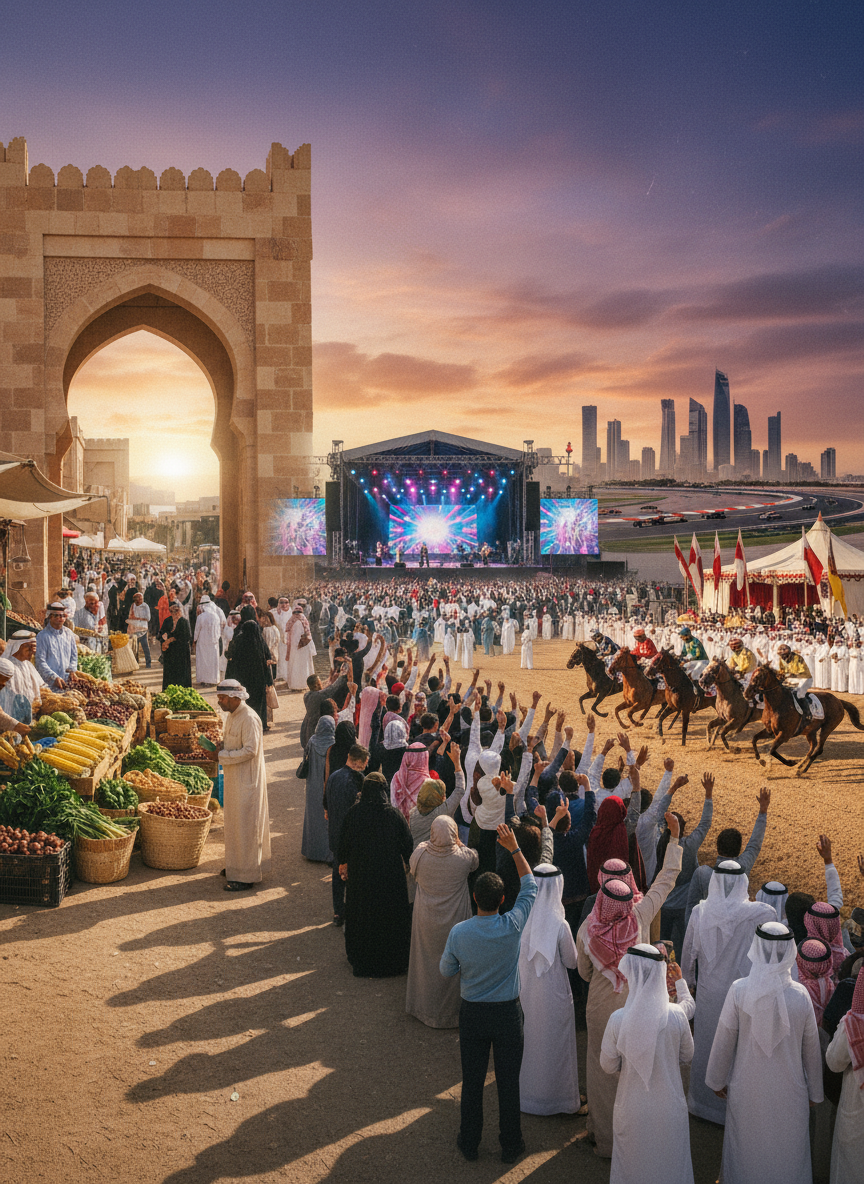
A’ali’s Cultural Identity Amid Major National Events
1/27/2026 OSpark
The article examines growing concern in A’ali over whether major events in Bahrain—such as the Budaiya Gardens Farmers’ Market, large concerts, royal horseracing festivals, the Autumn Fair, and Formula 1 festivities—are genuinely supporting local communities, Bahraini traditions, and emerging talents, or primarily serving external interests and elite audiences. It highlights perceptions of repetitive venues and VIP circles, questions the marginalization of A’ali in national event planning, and frames the call for greater recognition, equitable cultural investment, and authentic representation of Bahraini heritage.
A season of major public events in Bahrain has generated both excitement and criticism within the community of A’ali. Announcements surrounding the Budaiya Gardens Farmers’ Market, large-scale concerts, royal horseracing festivals, the Autumn Fair, and the upcoming Formula 1 activities have prompted renewed debate over cultural priorities, economic beneficiaries, and regional inclusion.
The Budaiya Gardens Farmers’ Market has been promoted as a focal point for agricultural activity and local produce, symbolized by its strong association with fresh products such as corn and other seasonal crops. This initiative is widely publicized as a platform for local farmers and small producers. However, concern has emerged regarding whether such markets effectively channel sustained support to grassroots producers from all regions, including A’ali, or whether they primarily function as high-visibility attractions oriented toward visitors and external audiences.
In parallel, a wide range of concerts and entertainment events has been scheduled across prominent national venues. These cultural and musical activities contribute to the country’s public image as a dynamic and modern destination. Nevertheless, recurring patterns are noted in the selection of locations, organizers, and invited guests, leading to perceptions that the same venues and the same circles of VIP attendees repeatedly dominate the cultural calendar. Such repetition has raised questions about the level of access provided to emerging artists and cultural practitioners from less spotlighted areas such as A’ali.
Two royal horseracing festivals, together with other high-profile equestrian events, form an important component of Bahrain’s traditional and ceremonial calendar. These occasions carry strong symbolic value and attract both national and international attention. Despite their prominence, critics argue that the benefits of these events, in terms of cultural visibility and economic opportunity, are often concentrated among established elites and central venues. This perception contributes to a sense of marginalization in communities that feel insufficiently represented in national cultural narratives.
The Autumn Fair, frequently described as a large-scale commercial and cultural showcase, further illustrates the tension between nationwide celebration and local recognition. While the fair presents opportunities for trade, exhibition, and entertainment, observers from A’ali have expressed concern that such flagship events rarely prioritize smaller, locally rooted initiatives. The central question raised is whether these fairs serve as inclusive platforms for Bahraini entrepreneurs and traditional craftspeople across all regions, or whether they primarily amplify already dominant commercial actors.
Speculation surrounding the Formula 1 Grand Prix and its associated festivities adds another dimension to the debate. Public interest often focuses on which international celebrities, teams, or public figures will appear in the paddock and associated events. While this global exposure is considered valuable for the national brand, critical voices highlight the limited visibility afforded to local cultural content, especially from smaller towns. This situation leads to concern that international spectacle may overshadow the representation of authentic Bahraini heritage and local creative talent.
At the core of the discussion lies a broader question regarding the authenticity and equity of cultural policy. Community members in A’ali express unease that many of these events are framed as celebrations of local identity and support for citizens, yet do not always translate into tangible development, sustained opportunities, or meaningful cultural participation for all regions. The recurring involvement of the same locations, organizational structures, and VIP networks is perceived as evidence of entrenched patterns that are difficult to change.
Particular attention is directed toward the status of A’ali within the national cultural landscape. Residents and cultural advocates argue that A’ali remains largely in the background despite possessing rich heritage, strong community identity, and notable young talents. The town is often regarded as an afterthought in event planning, rather than as a central stage for national cultural expression. This perceived marginalization has intensified calls for more balanced distribution of events, investments, and platforms.
The debate also highlights concerns about the preservation and promotion of Bahraini traditions. Commentators contend that certain events emphasize spectacle and entertainment while offering only a limited or stylized representation of local customs, crafts, and folklore. In this view, an overreliance on large, centralized, and commercially driven events risks producing a form of culture that is more performance-oriented for external audiences than rooted in everyday community practice.
Young talents from A’ali constitute another focal point of criticism. Many feel that opportunities for emerging artists, musicians, performers, and entrepreneurs remain constrained by structural barriers in access to major stages and official programs. The repetition of the same established names is seen as limiting the renewal and diversification of cultural expression. As a result, demands have intensified for transparent, inclusive mechanisms that would allow new voices from A’ali and similar communities to participate in flagship national events.
Underlying these concerns is a wider discourse on who benefits financially and symbolically from the current model of events. Questions are raised as to whether the primary gains accrue to external stakeholders, commercial sponsors, and select social groups, rather than being broadly distributed across local communities. The perception that others are "cashing in" on culture, while certain regions remain sidelined, fuels frustration and a sense of inequity.
Public commentary from A’ali increasingly calls for structural change rather than symbolic gestures. Key demands include more geographically diverse event planning, sustained support for local producers and artists, transparent selection criteria for participation in major festivals, and genuine integration of Bahraini traditions into large-scale programs. The objective is not merely increased visibility, but a reconfiguration of cultural policy that recognizes A’ali and similar communities as integral contributors to national identity.
As Bahrain enters another season of prominent events, the debate centered on A’ali underscores a critical tension between spectacle and inclusion. The outcome of this discussion may influence future approaches to cultural planning, heritage preservation, and youth engagement across the country. Whether upcoming seasons will deliver substantive change or continue existing patterns remains a subject of ongoing public scrutiny and expectation.




![🚨PromptShare🚨
Glowing portrait Prompt
PROMPT
Advertisement for [character with face lit by a unique, story-driven light effect tied to their identity],
creating a hologram effect. 80s-style poster aesthetic, glowing light emanating against a dark background. the photograph](https://pbs.twimg.com/media/HE6eu1nWUAAsDVm.jpg)
