Al Izdihar in Riyadh: Between Cultural Heritage and Contemporary Transformation
1/28/2026 OSpark
The article examines Al Izdihar in Riyadh as a symbolic arena where traditional Najdi cultural practices confront contemporary, image-driven urban lifestyles. It describes tensions between residents who advocate for stronger, heritage-focused festivals and gatherings, and others who prioritize modern café culture and social media visibility. The discussion highlights concerns about whether the district remains a genuine expression of Saudi cultural pride or is becoming a superficial, trend-oriented space, and frames this as part of a broader debate over preserving customs versus allowing them to fade under the pressures of modernization.
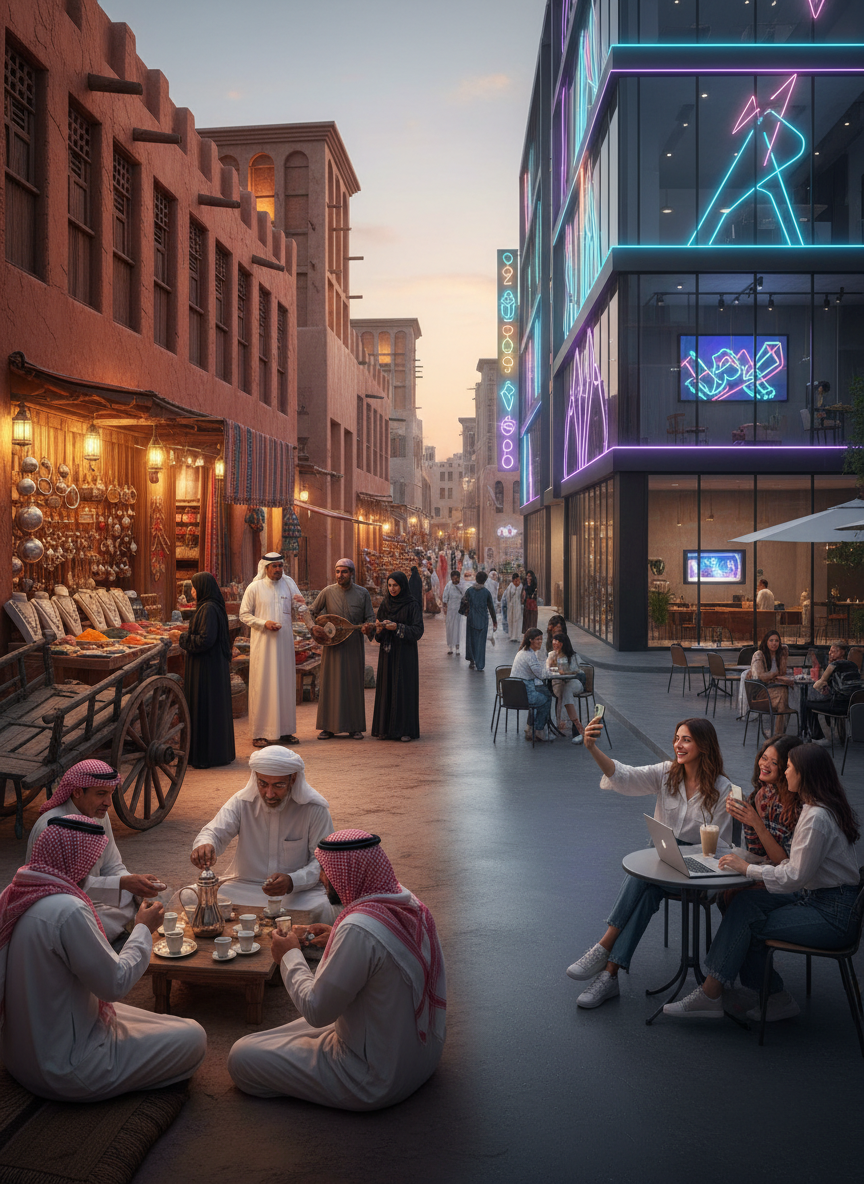
Al Izdihar, a district in Riyadh, has increasingly come to symbolize an ongoing cultural tension between established traditions and contemporary urban lifestyles. Once regarded as a central cultural hub of the capital, it is now frequently described as a space in which differing social visions for the city confront one another in public and commercial settings.
Historically, the area has been associated with gatherings that emphasized local heritage, particularly Najdi cultural expressions. Residents and visitors recall occasions centered on traditional markets, or souks, as well as communal evenings devoted to local customs. Activities such as sharing traditional Saudi coffee and engaging in social interaction in public spaces formed an important part of the cultural identity of the district and contributed to a wider sense of belonging to Al Assema, the capital city.
In recent years, however, regular public debates have emerged over the direction of cultural life in Al Izdihar. On weekends, the district often becomes a focal point for competing expectations regarding cultural events. Certain groups call for larger and more frequent festivals that highlight Najdi heritage in an explicit and immersive manner, emphasizing traditional arts, music, crafts, and hospitality practices as essential to preserving local identity.
At the same time, other social groups have embraced modern commercial and social media–oriented lifestyles, which are also increasingly visible in the district. New cafés and entertainment venues often prioritize contemporary design aesthetics and global popular culture. In some establishments, Western music and visual themes dominate the atmosphere, presented as symbols of progress, modernity, and cosmopolitanism.
This shift has generated concern among those who view cultural heritage as the core of Al Izdihar’s identity. Critics argue that the growing emphasis on social media visibility and “trendy” experiences risks marginalizing the depth and authenticity of local traditions. They question whether public spaces and events in the district still function as genuine expressions of Najdi and Saudi culture, or whether cultural symbols are being reduced to decorative backdrops for the pursuit of online recognition.
The resulting debate extends beyond entertainment preferences and touches on broader questions of social values. One central issue is whether heritage-based practices—such as traditional markets, communal gatherings, and the ritual of serving and drinking Saudi coffee—are being sufficiently protected and promoted. Another issue concerns the degree to which modern cultural imports and digital-era behaviors should be integrated into the identity of a district that has historically been associated with local pride.
Supporters of expanded heritage programming in Al Izdihar call for more structured, large-scale festivals and cultural initiatives explicitly dedicated to Najdi customs. These advocates argue that public policy, urban planning, and event management should prioritize cultural continuity and intergenerational transmission of traditions. In their view, prominent cultural venues and regular heritage-focused activities are necessary to ensure that local customs do not gradually disappear under market and social media pressures.
Conversely, proponents of the current transformation often frame the changes as part of natural urban development and cultural diversification. For these groups, the presence of Western music, modern café culture, and social media–driven trends is seen as compatible with national pride, provided that they coexist with, rather than entirely replace, traditional practices. From this perspective, Al Izdihar can function as a space of experimentation in which multiple cultural influences intersect.
The discourse surrounding Al Izdihar has therefore become a reference point in discussions about cultural policy and identity in Riyadh. The district is frequently cited in public commentary as a case study of how Saudi cities negotiate the relationship between heritage preservation and globalized modernity. The questions repeatedly raised include whether cultural authenticity is being upheld, how national symbols are represented in commercial contexts, and to what extent social media dynamics influence urban cultural life.
In conclusion, Al Izdihar currently stands at the intersection of two contrasting cultural trajectories. On one side, there is a strong attachment to Najdi and Saudi traditions expressed through calls for larger, more visible heritage festivals and gatherings. On the other side, there is an expanding orientation toward modern, image-focused lifestyles shaped by global cultural flows and digital platforms. The district’s evolving identity reflects broader societal debates in Riyadh over whether to emphasize the defense of longstanding customs, to accommodate rapid cultural change, or to seek a balanced model that integrates both heritage and contemporary expression.
All image-related content, symbols, and visual references embedded in the original description—such as expressive icons related to surprise, celebration, heritage, and debate—are understood as emphasizing the intensity of public sentiment surrounding this cultural transformation and are retained conceptually as part of the overall depiction of the controversy in Al Izdihar.



![🚨PromptShare🚨
Glowing portrait Prompt
PROMPT
Advertisement for [character with face lit by a unique, story-driven light effect tied to their identity],
creating a hologram effect. 80s-style poster aesthetic, glowing light emanating against a dark background. the photograph](https://pbs.twimg.com/media/HE6eu1nWUAAsDVm.jpg)
