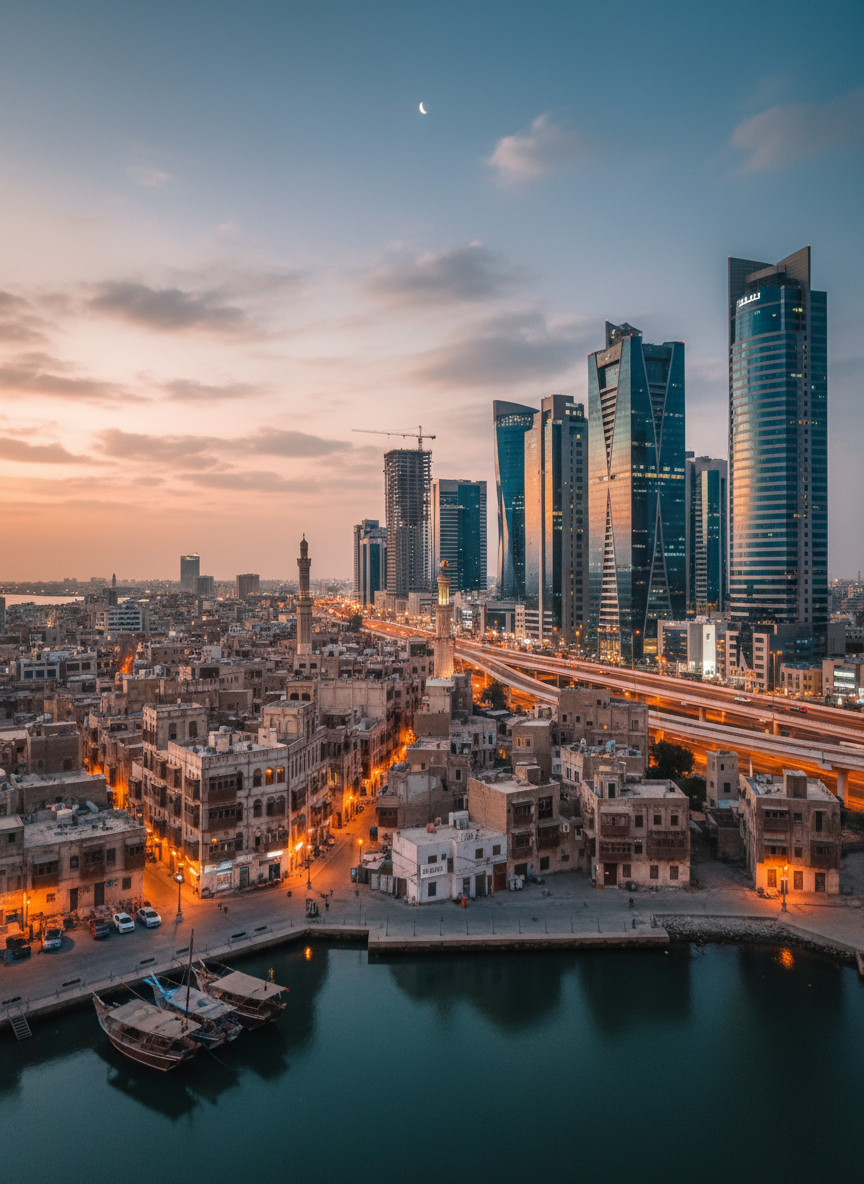
Jeddah’s Heritage at a Crossroads: Preserving Al-Balad Amid Rapid Modernization
1/28/2026 OSpark
The article examines the tension between heritage preservation and rapid urban development in Jeddah, focusing on the historic district of Al-Balad and its fading traditional architecture, markets, and local narratives. It highlights concerns over the neglect and demolition of ancestral homes, the overshadowing of cultural identity by contemporary mega-projects, and the under-recognition of historical figures, including influential women of Jeddah. The text calls for a re-evaluation of development priorities to ensure that economic progress does not come at the expense of the city’s cultural soul and historical legacy.
Jeddah, historically known as the gateway to the Holy Cities and a major port on the Red Sea, has long been characterized by its distinctive traditional architecture, bustling souqs, and layered local narratives. Before the rise of modern towers and commercial complexes, the urban fabric of the city was defined by coral-stone houses, intricately carved wooden mashrabiyyat, and narrow alleyways that reflected centuries of social, economic, and cultural interaction.
A central symbol of this legacy is Old Jeddah (Al-Balad), recognized as a UNESCO World Heritage Site. This district once contained a dense concentration of historic residences, merchant houses, and traditional markets that documented the evolution of urban life in the Hijaz region. The architectural forms, materials, and spatial organization in Al-Balad represented a unique response to climate, trade, and religious pilgrimage, and served as a living archive of Red Sea and Hijazi culture.
In recent decades, however, rapid urban development and large-scale modernization projects have altered the city’s physical and cultural landscape. High-rise buildings, modern infrastructure, and expansive commercial centers have increasingly dominated the skyline. In this process, many historic houses have been neglected, left in disrepair, or demolished. The disappearance or decay of these structures has raised concerns regarding the erosion of collective memory and the loss of tangible links to earlier generations.
The tension between development and preservation is frequently framed as a trade-off between economic growth and cultural continuity. On one side, proponents of accelerated modernization emphasize investment, new infrastructure, and the global visibility that comes with mega-projects. On the other, heritage advocates underscore that urban progress should not come at the cost of architectural and cultural extinction, particularly in a city whose identity has long been anchored in its role as “Jawharat Al-Hijaz” (the Jewel of the Hijaz).
Beyond the built environment, the city’s intangible heritage—stories, customs, and local histories—also faces the risk of marginalization. Many of Jeddah’s historic neighborhoods nurtured complex social networks, oral traditions, and narratives of struggle, resilience, and innovation. Among these are the accounts of traders, craftsmen, and religious scholars who shaped the city’s evolution, as well as lesser-documented stories of ordinary residents whose lives were intertwined with the historic streets and markets.
Particularly significant, yet often underrepresented, are the contributions of Jeddah’s women to the social and economic fabric of the city. Historical records and local accounts point to women who participated in trade, property management, education, and community organization. These figures influenced the development of neighborhoods, supported family enterprises, and played key roles in sustaining communal life. The diminishing physical settings in which these histories unfolded makes it more difficult to preserve and transmit such narratives to future generations.
Al-Balad’s recognition by UNESCO has brought international attention to its value, yet the condition of many ancestral homes and heritage structures remains precarious. Some buildings have been restored and conserved in line with heritage standards, while others stand abandoned or structurally compromised. The contrast between celebrated monuments and neglected properties highlights ongoing challenges in funding, regulatory enforcement, maintenance, and adaptive reuse.
The broader public debate increasingly revolves around a central question: whether the pursuit of contemporary urban prosperity is overshadowing the city’s historical identity and cultural authenticity. Critics argue that the dominance of new commercial complexes and visually imposing developments risks reducing heritage to a symbolic backdrop rather than an integrated, living component of urban life. In this view, the city’s “soul” resides in its historical urban fabric, social memory, and inherited values, not solely in its modern skyline.
Heritage preservation in Jeddah, as in many rapidly developing cities, involves a multidimensional approach. It requires documentation and restoration of historic structures, legal and planning frameworks that prioritize cultural sites, and educational initiatives to raise awareness of the city’s past. It also entails recognition of the full spectrum of historical actors, including women and marginalized groups, whose experiences have shaped the city but may not be prominently reflected in official narratives.
The case of Jeddah illustrates a broader regional and global challenge: how to balance modernization with the safeguarding of cultural heritage. The outcome of this process will influence not only the visual appearance of the city but also its sense of identity and continuity. Decisions made regarding Al-Balad and other historic areas will determine the extent to which future generations can engage with authentic traces of their ancestors’ lives, struggles, and achievements.
In this context, ongoing discourse about Old Jeddah, its historic houses, souqs, and local stories is not merely a matter of nostalgia. It reflects a critical debate over values, priorities, and the meaning of progress. The preservation or loss of this heritage will shape how Jeddah is remembered, both by its residents and by the wider world, as either a city that integrated its past into its future or one that allowed its historical identity to fade amid the pursuit of modern development.



![🚨PromptShare🚨
Glowing portrait Prompt
PROMPT
Advertisement for [character with face lit by a unique, story-driven light effect tied to their identity],
creating a hologram effect. 80s-style poster aesthetic, glowing light emanating against a dark background. the photograph](https://pbs.twimg.com/media/HE6eu1nWUAAsDVm.jpg)
