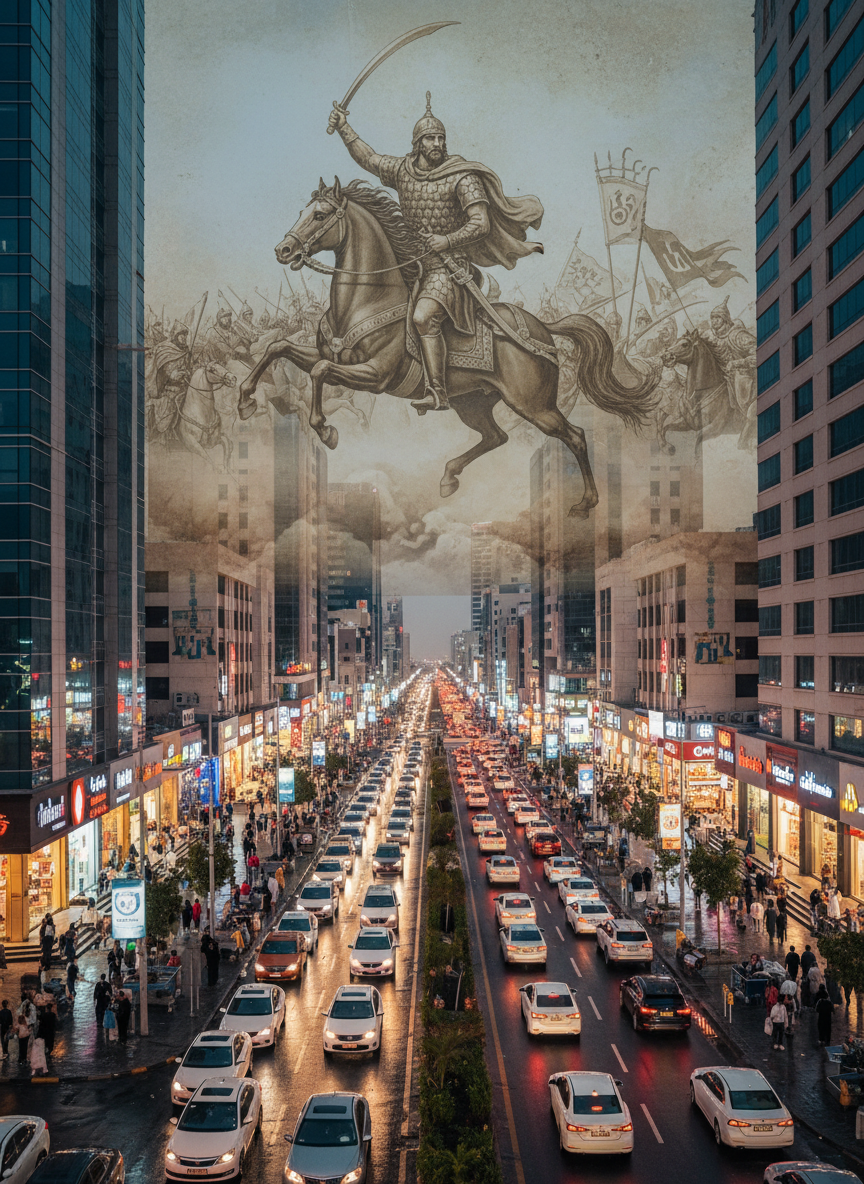
Khalid bin Al Waleed Street in Riyadh: A Neglected Layer of Urban Memory
1/22/2026 OSpark
OSparkThe article examines Khalid Bin Al Waleed Branch Street in Al Rawda, Riyadh, highlighting the gap between its historically significant name and the lack of visible commemoration in the urban landscape. It argues that a street named after one of early Islam’s greatest military figures currently functions as a regular commercial corridor devoid of historical storytelling. The article calls for urban and cultural initiatives—such as murals, plaques, mini-museums, and digital heritage experiences—to transform the street into a meaningful heritage stop for residents, students, and tourists, and reflects on the broader issue of historical memory in a rapidly modernizing city.
Riyadh contains numerous streets and districts whose names reference foundational figures and events in Islamic and national history. Among these is Khalid Bin Al Waleed Branch Street in the Al Rawda district, named after one of the most renowned military commanders in early Islamic history, often known by the honorific “Sword of Allah.” Despite the weight of this historical name, the physical and visual environment of the street currently presents itself primarily as a commercial and traffic corridor, with little or no visible interpretation of the figure it commemorates.
Khalid bin Al Waleed occupies a central place in early Islamic history due to his strategic acumen, key role in several decisive battles, and contribution to the expansion and consolidation of the early Muslim state. His campaigns are studied as examples of military leadership, logistical planning, and battlefield innovation. A street bearing his name therefore represents an opportunity to embed historical education and cultural memory directly into the urban fabric, especially in a capital city aspiring to global status.
In its present form, however, Khalid Bin Al Waleed Branch Street in Al Rawda is characterized by everyday commercial activity: restaurants, cafés, small shops, and dense traffic. The name appears on maps and signage, but there is no systematic effort to narrate the life of Khalid bin Al Waleed, his campaigns, or his wider historical significance. This disconnect underscores a broader tension between rapid urban modernization and the preservation and activation of historical memory in public space.
The phenomenon raises a critical question in contemporary urban and cultural planning: how can a city modernize its infrastructure and services without erasing, marginalizing, or leaving dormant its own historical narratives? In the case of this particular street, the absence of murals, plaques, interpretive panels, or dedicated heritage installations illustrates how historical names can become symbolic markers devoid of contextual content, especially for younger generations and visitors who may have limited background knowledge.
International urban heritage practices suggest that a variety of tools can be deployed to activate such historically named corridors. These include murals depicting key moments from the life and campaigns of Khalid bin Al Waleed; street plaques providing concise, well-researched biographical information; and small-scale interpretive elements integrated into sidewalks, façades, or public seating areas. Such interventions can transform a routine commercial street into a layered urban space where daily life coexists with historical education.
Digital technologies also offer additional possibilities for deepening engagement with the historical figure behind the street name. Augmented reality (AR) applications, QR codes on lamp posts or building façades, and location-based audio guides could provide interactive narratives, maps of early campaigns, and timelines of Khalid bin Al Waleed’s role in early Islamic history. These tools align with Riyadh’s ambition to position itself as a technologically advanced global city, while simultaneously reinforcing cultural identity and historical awareness.
Educational integration is another important dimension. The street could be incorporated into school excursions, university urban studies projects, and heritage tourism circuits. Structured visits that combine classroom learning with on-site interpretation would enable students to connect abstract historical content with tangible urban spaces. For tourists, curated walking routes in Al Rawda that highlight Khalid Bin Al Waleed Branch Street as a heritage stop could diversify the city’s cultural offerings beyond the more frequently promoted sites such as Diriyah and old Riyadh.
Community participation represents a further opportunity for strengthening the street’s identity as a living tribute rather than a nominal designation. Long-time residents, shop owners, and local institutions could contribute archival photographs, memories, and documents that demonstrate how the area has evolved over time. Such material could be displayed in mini-exhibitions, outdoor panels, or community-managed micro-museums, thereby linking the historical figure of Khalid bin Al Waleed with the social history of Al Rawda itself.
The emotional responses of residents and observers to the current state of the street range from pride in the historical significance of the name to frustration at the lack of visible commemoration. These reactions highlight a growing awareness that urban nomenclature alone is insufficient to preserve cultural memory. Without supporting visual, educational, and interpretive frameworks, historically meaningful names risk becoming mere reference points on digital maps and road signs.
In the context of Riyadh’s transformation into a global future city, Khalid Bin Al Waleed Branch Street in Al Rawda can serve as a case study in how to reconcile modernization with heritage. By introducing thoughtfully designed physical and digital storytelling elements, integrating the street into educational and tourism programs, and encouraging community engagement, city planners and cultural stakeholders can convert a largely ordinary commercial corridor into a genuine urban tribute to one of Islamic history’s most prominent military leaders. Such an approach would demonstrate that progress and memory need not be in opposition, but can be woven together in the daily spaces of the city.




![🚨PromptShare🚨
Glowing portrait Prompt
PROMPT
Advertisement for [character with face lit by a unique, story-driven light effect tied to their identity],
creating a hologram effect. 80s-style poster aesthetic, glowing light emanating against a dark background. the photograph](https://pbs.twimg.com/media/HE6eu1nWUAAsDVm.jpg)
