Sharq’s Transformation: Heritage, Modernization, and the Loss of an Urban Memory
2/4/2026 OSpark
The article examines the transformation of historic Sharq in Kuwait, with a focus on Ahmed Al-Jaber Street, from a traditional commercial and social hub into a modern district dominated by high-rise buildings, malls, and heavy traffic. It highlights concerns about the erasure of architectural and cultural heritage, including old houses, mosques, and artistic elements, and recalls Sharq’s historical role in trade, politics, and maritime life. The text raises critical questions about whether recent development represents progress or cultural loss, emphasizing the need to acknowledge and preserve the district’s historical identity.
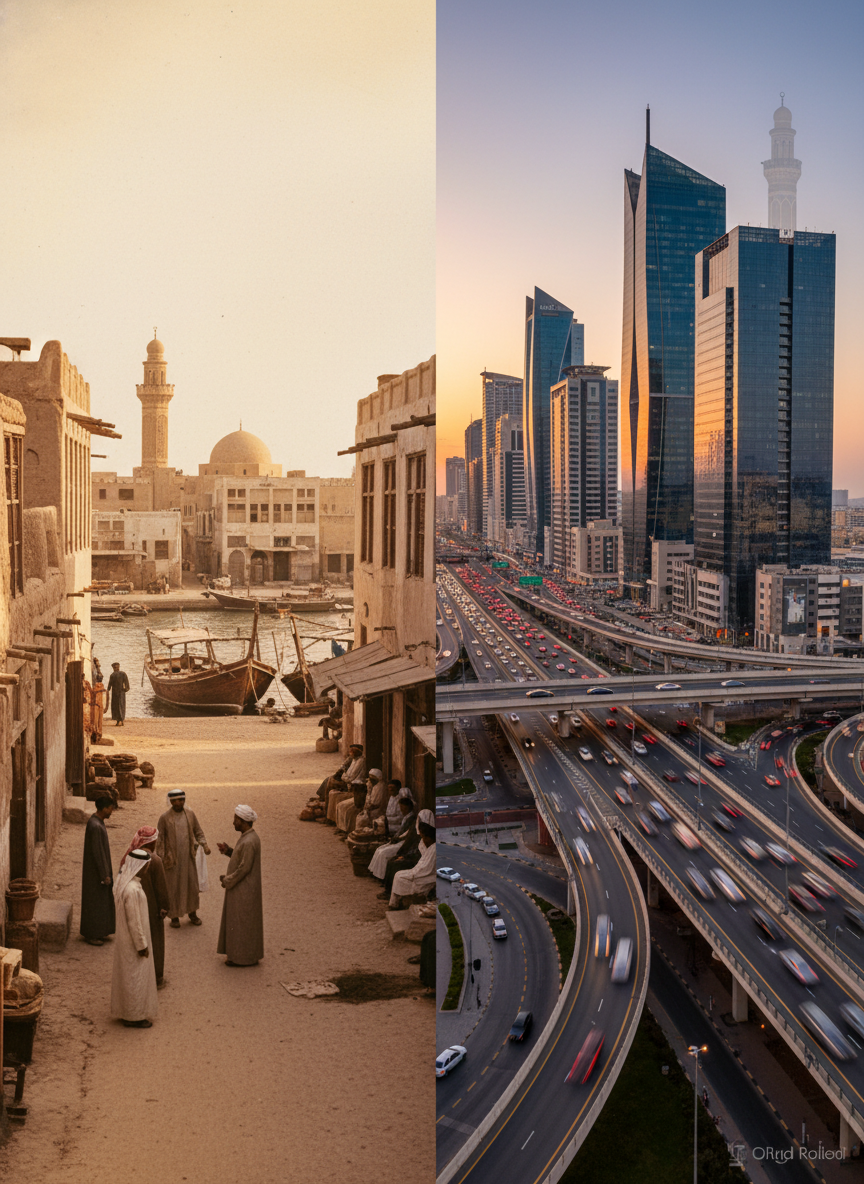
Sharq, one of Kuwait City’s oldest districts, has undergone a profound transformation over recent decades. Once characterized by traditional homes, narrow streets, and historic public spaces, it is now marked by glass towers, dense road networks, and continuous traffic congestion. This change is particularly evident along Ahmed Al-Jaber Street, which historically functioned as a central artery in the area’s social and commercial life and is today largely dominated by modern office blocks, commercial complexes, and contemporary urban infrastructure.
Historically, Sharq served as a core center of Kuwait’s urban and cultural development. It was closely associated with the rise of the merchant class, whose commercial activities helped shape the economic foundations of the country. Within its neighborhoods, commercial exchanges, negotiations, and agreements played a decisive role in linking local trade with regional and international markets. The district was also the setting for discreet political meetings that contributed to the formation of early political discourse and civic engagement in Kuwait.
Sharq’s identity was further enriched by its maritime and coastal character. Many of Kuwait’s fishing and seafaring communities were connected to this area, and numerous accounts describe generations whose daily lives revolved around the sea, fishing, pearling, and trade across the Gulf. Such stories, passed down through families, provided a living memory of hardship, resilience, and communal solidarity. These experiences were embedded in the built environment: in the layout of streets, the design of houses, and the proximity to the shore and traditional markets.
Ahmed Al-Jaber Street, in particular, represented more than a simple transit route. Before the major urban changes of the late 20th century, the street and its surroundings included historic houses, neighborhood mosques, and architectural details that reflected local building traditions and social norms. Many of these structures have since been demolished or significantly altered, replaced by office towers, commercial centers, and contemporary amenities. As a result, much of the tangible evidence of daily life in pre-oil Kuwait has been removed from the visible urban landscape.
The transformation of Sharq has raised critical questions concerning the balance between modernization and heritage preservation. The replacement of old homes with large concrete and glass structures, the fading presence of historic mosques, and the removal or covering of traditional art and ornamentation are viewed by many observers as a systematic erosion of cultural memory. Sites that once conveyed the social, religious, and architectural history of Kuwait have in many cases given way to international retail chains, cafes, and high-end commercial real estate.
This shift has been interpreted by some as a form of gentrification. As land values increased and development projects multiplied, long-standing communities and their traditional spaces were displaced or marginalized. The emergence of new malls, luxury offices, and high-end residential towers created an urban environment oriented toward consumption, status, and modern aesthetics, often at the expense of historic continuity. This change has altered not only Sharq’s skyline but also its social fabric and its role as a keeper of collective memory.
Within this broader historical context, reference is often made to significant cultural and social turning points, including episodes such as the 1931 prohibition of the traditional cloak known as the “besht.” Although originating in a specific political and social framework, such measures symbolized tensions between evolving norms and deeply rooted customs. For many historians and cultural observers, these episodes illustrate a long-standing struggle between tradition and modernization in Kuwait’s public life, a struggle that is reflected today in the physical transformation of districts such as Sharq.
The current urban form of Sharq prompts ongoing debate about cultural identity and historical consciousness. Questions are posed as to whether the district still reflects the authentic character of Kuwait or whether it has become a near-generic zone of high-rise buildings and vehicle-dominated streets. The disappearance of historic homes, the diminishing visibility of old mosques, and the loss of traditional artistic details suggest a gap between the area’s historical significance and its contemporary representation.
The contrasting images of old Sharq and present-day Sharq reveal two competing visions of progress. On one hand, the new skyline, modern infrastructure, and commercial developments are cited as signs of economic growth and national advancement. On the other hand, the erasure of heritage architecture, the fading of local narratives tied to specific sites, and the decline of traditional urban forms are perceived as a form of cultural dispossession. In this view, development without systematic documentation and preservation risks transforming a once culturally distinctive district into a space lacking historical depth.
Discussions surrounding Sharq’s future therefore focus on the need for integrated strategies that recognize and protect historic layers of the urban fabric. Such strategies might include the restoration of remaining heritage buildings, legal and planning frameworks that safeguard significant sites, and the incorporation of historical references into new architectural and urban projects. Public history initiatives, including research, exhibitions, and educational programs, can further contribute to reviving knowledge of what once stood on streets such as Ahmed Al-Jaber before the large-scale changes of the 1980s.
Ultimately, the case of Sharq reflects a broader challenge facing many rapidly modernizing cities in the Gulf region and beyond. The tension between economic development and heritage conservation calls for deliberate choices about what aspects of the past are preserved, documented, and integrated into contemporary life. The transformation of Sharq from a historic coastal district rich in merchant culture, political discourse, and maritime tradition into a landscape dominated by modern commercial architecture underscores the urgency of addressing these questions in a systematic and informed manner.
No images were included in the original text, and thus no image references are retained in this version.




![🚨PromptShare🚨
Glowing portrait Prompt
PROMPT
Advertisement for [character with face lit by a unique, story-driven light effect tied to their identity],
creating a hologram effect. 80s-style poster aesthetic, glowing light emanating against a dark background. the photograph](https://pbs.twimg.com/media/HE6eu1nWUAAsDVm.jpg)
