Tan-Tan: An Underrated Cultural Crossroads in Southern Morocco
1/24/2026 OSpark
OSparkThe article examines Tan-Tan in the Guelmim-Oued Noun region as an underappreciated destination in Morocco. It highlights its desert landscapes, Atlantic coastline, ksours, and the Moussem of Tan-Tan, while critically assessing local hospitality, heritage preservation, and the gap between residents’ perceptions and growing external interest. It concludes by contrasting sites considered overrated with those that deserve broader international recognition.
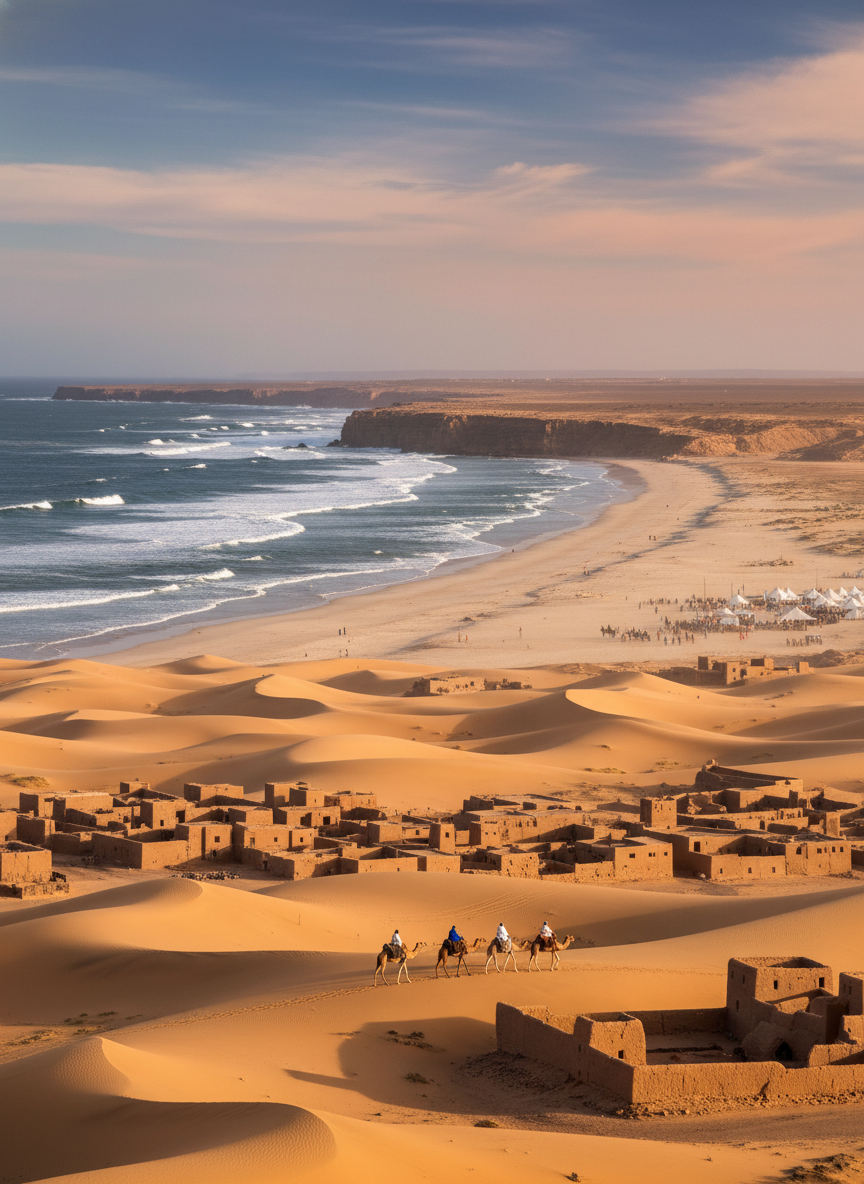
Tan-Tan, located in the Guelmim-Oued Noun region of southern Morocco, remains one of the country’s most overlooked destinations despite its diverse natural and cultural assets. While many domestic visitors characterize the area as having “nothing to see,” the territory encompasses extensive desert landscapes, historic ksours, and a dramatic Atlantic coastline. This contrast between perception and reality has contributed to Tan-Tan’s status as an underrated destination within the national tourism landscape.
The surrounding desert offers a distinctive environment where sand formations resemble waves, creating a shifting topography that changes with the wind. These sands often frame ancient ksours and small settlements that bear witness to caravan routes and long-standing trans-Saharan exchanges. The region’s built heritage, though not always restored or promoted with the same intensity as monuments in larger cities, retains significant historical and cultural value.
On the Atlantic side, the coastline near Tan-Tan, including the well-known Plage Blanche, presents a wild and relatively unspoiled seafront. Strong ocean swells, cliffs, and wide sandy expanses distinguish this stretch of coast from more heavily developed beach destinations in Morocco. The area’s relative isolation has preserved a sense of remoteness that appeals to visitors seeking off-the-beaten-path experiences, while also limiting tourism infrastructure and broader recognition.
Among the most prominent cultural events associated with Tan-Tan is the Moussem of Tan-Tan, a major gathering of Saharan and tribal communities. Recognized by UNESCO as Intangible Cultural Heritage, this moussem functions as a convergence point for pastoral traditions, music, dance, and oral heritage. Participants engage in equestrian performances, traditional ceremonies, and communal festivities. Local gastronomy, including dishes prepared with camel meat, forms an integral part of this event, reinforcing the relationship between nomadic heritage, animal husbandry, and festive culture.
Hospitality is frequently cited by inhabitants of Guelmim-Oued Noun as one of the region’s defining characteristics. This reputation, however, raises questions regarding the depth and authenticity of interactions between residents and visitors. In some cases, local engagement with tourism is reduced to repetitive commercial exchanges, such as serving tea or offering basic services, rather than fostering meaningful cultural dialogue or interpretation of heritage. This dynamic can contribute to the underappreciation of the region’s intangible cultural wealth.
At the same time, external observers, including national and international visitors, often express admiration for the region’s desert sunsets, open horizons, and sense of vastness. This outside enthusiasm contrasts with a certain local ambivalence and occasionally limited promotion of heritage resources. While some inhabitants may consider their environment ordinary or monotonous, visitors frequently regard the same landscapes as exceptional, underscoring a gap between lived familiarity and touristic perception.
Within public debates on regional tourism, certain locations and experiences in Tan-Tan are sometimes described as overrated, while others are regarded as deserving of greater visibility. Sites that receive occasional attention without corresponding cultural contextualization can risk being reduced to simple photo opportunities, potentially diminishing their perceived value. By contrast, locations such as Plage Blanche, lesser-known ksours, and the full cultural program of the Moussem of Tan-Tan are often cited as assets capable of sustaining international recognition if supported by more structured conservation and promotion strategies.
The discussion surrounding Tan-Tan’s status—whether as an underrated gem or a neglected territory—reflects broader questions about heritage management, community engagement, and regional development in Morocco. Sustained attention to intangible cultural practices, historic architecture, and natural landscapes, combined with thoughtful tourism planning, could reposition Tan-Tan as a significant cultural and environmental destination. In this context, the region’s identity as the “soul” of Guelmim-Oued Noun gains renewed relevance, not only as a point of local pride but as a resource of national and international interest.




![🚨PromptShare🚨
Glowing portrait Prompt
PROMPT
Advertisement for [character with face lit by a unique, story-driven light effect tied to their identity],
creating a hologram effect. 80s-style poster aesthetic, glowing light emanating against a dark background. the photograph](https://pbs.twimg.com/media/HE6eu1nWUAAsDVm.jpg)
